Parents often ask a simple but important question: How can I help my child stand out while developing skills that truly matter for college, careers, and life?
For many families, the answer begins with college readiness through invention projects. Invention education gives students opportunities to identify meaningful problems, conduct research, develop solutions, build prototypes, test ideas, and communicate their work. Along the way, students develop creativity, confidence, persistence, collaboration, and real-world problem-solving skills.
During a recent DRIPBL Speaker Series event, Brenda Payne, Executive Director of the California Invention Convention, shared how invention education can help students become confident thinkers capable of tackling meaningful challenges. Payne has spent decades supporting students through project-based learning, engineering design, and invention education across California.
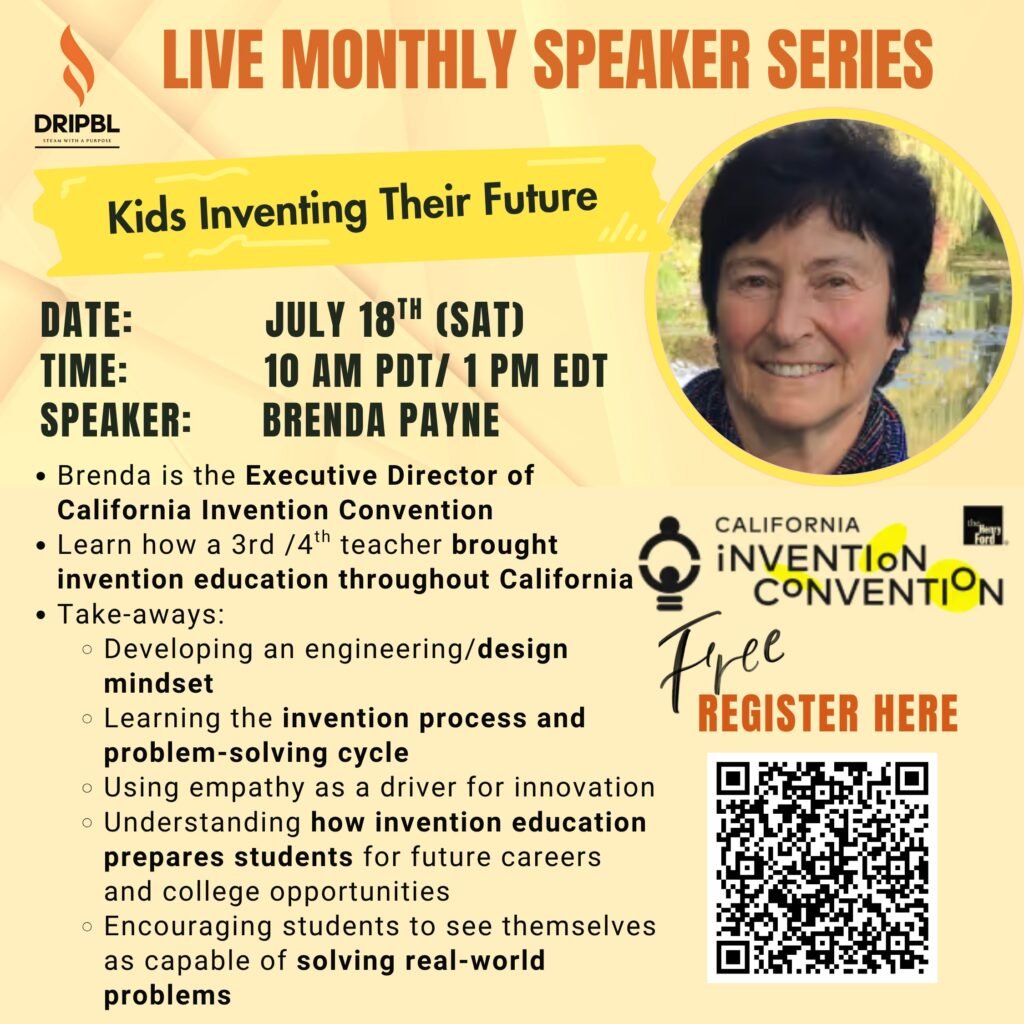
Brenda Payne, Executive Director of the California Invention Convention, joined the DRIPBL Speaker Series to discuss invention education, creativity, and student success.
Watch Brenda Payne’s Full Presentation
| Key Takeaways for Families and Educators Creativity can be practiced and strengthened.Meaningful projects help students build persistence and confidence.Invention begins with empathy and careful observation.Long-term projects can demonstrate qualities colleges value.Competitions give students deadlines, feedback, and authentic audiences. |
What Is Invention Education?
At its core, invention education teaches students how to identify problems and develop solutions. Students observe the world around them, ask questions, investigate challenges, generate ideas, build prototypes, test their designs, and communicate what they have learned.
The process blends STEM, entrepreneurship, creativity, communication, and critical thinking into one meaningful learning experience. The Lemelson-MIT Program has helped advance invention education as a transdisciplinary, problem-centered approach that prepares young people to become innovators and problem solvers.
Unlike assignments focused on finding one correct answer, invention projects ask students to create something new. Setbacks become opportunities to revise, test, and improve. That mindset is valuable in STEM, college, careers, entrepreneurship, and everyday life.
Why Creativity Matters More Than Ever
One of the most memorable parts of Brenda Payne’s presentation focused on creativity. She referenced research suggesting that young children often demonstrate strong creative-thinking abilities, while those abilities may decline when students have fewer opportunities to explore, question, and invent.
Many students spend years learning how to provide the expected answer. Invention education helps restore space for imagination by asking students to identify problems, generate possibilities, test solutions, and improve their work.
| “Creativity is like riding a bike. It can be practiced and relearned.” — Brenda Payne |
Creativity is not limited to students who already think of themselves as artistic or inventive. It is a skill that grows through use. Every observation, sketch, prototype, revision, and presentation gives students another opportunity to practice it.
Why Early Exposure to Innovation Matters
Research supports the importance of exposing students to innovation, role models, and creative problem-solving opportunities early. The landmark paper Who Becomes an Inventor in America? examined how childhood circumstances and exposure influence who later becomes an inventor.
The researchers used the phrase “Lost Einsteins” to describe young people whose innovative potential may never be realized because they lack access to opportunities, role models, or pathways into innovation. For families and schools, the lesson is clear: talent is widely distributed, but exposure is not.
Programs such as the California Invention Convention, Invention Convention Worldwide, the Innovation and Invention Challenge, and DRIPBL’s research programs can help students see themselves as inventors, researchers, engineers, entrepreneurs, and leaders.
The Invention Process Mirrors Real Engineering and Research
Invention education closely mirrors the work of engineers, scientists, researchers, and entrepreneurs. The Invention Convention curriculum guides students through a structured process that includes:
- Identifying problems
- Understanding and researching those problems
- Generating possible solutions
- Designing a promising solution
- Building a prototype
- Testing and improving the design
- Communicating findings and impact
This sequence aligns with the Next Generation Science Standards for engineering design. Educators can also explore NGSS engineering resources from TeachEngineering for classroom-ready standards connections.
Students are not simply building objects. They are learning how to define challenges, evaluate evidence, manage projects, analyze results, respond to feedback, and communicate decisions.
Parent Takeaway
Invention projects are more than extracurricular activities. They help students build many of the competencies colleges and employers seek:
- Critical thinking
- Communication
- Collaboration
- Creativity
- Leadership
- Project management
- Persistence
- Resilience
Why Schools, Districts, and CTE Leaders Are Paying Attention
For teachers, administrators, STEM coordinators, and Career and Technical Education leaders, project-based invention education offers a flexible framework that can support:
- STEM and engineering initiatives
- Entrepreneurship programs
- CTE pathways
- Makerspaces
- After-school programs
- NGSS implementation
- Project-Based Learning
The Lemelson-MIT PiE invention education program provides additional tools and examples for schools seeking to build student-centered invention experiences.
Because students work on real problems that matter to them personally, invention projects can create deeper engagement than assignments with no authentic audience or purpose.
The Competition Pathway: From Local Ideas to National Impact
Many parents are unfamiliar with how invention competitions operate. Although requirements vary by program, the invention competition process typically follows a structured pathway that gives students time to research, build, test, revise, and present their work.
| Fall: Identify and Investigate Students identify meaningful problems, conduct background research, interview potential users, and begin developing invention concepts. |
| Winter: Prototype and Gather Feedback Students build prototypes, test early designs, gather user feedback, document revisions, and participate in school- or local-level invention competitions. |
| Spring: Advance to Regional and State Events Top projects may advance to regional and state-level events, including the California Invention Convention. |
| June: Present on a National Stage Selected students may advance to Invention Convention U.S. Nationals at The Henry Ford Museum of American Innovation. |
Competitions give student inventors a valuable structure for completing long-term work. Deadlines encourage project management, judging provides outside feedback, and presentations help students learn to explain both their process and their impact. Families can review invention competition timelines and national pathways, while the Innovation and Invention Challenge offers another opportunity for students to present original work.
| Why Starting Early Matters Brenda strongly encourages students to begin as early as August or September. Invention projects benefit from time, iteration, and refinement. Students who start early have more opportunities to investigate the problem, test ideas, improve prototypes, document their process, and strengthen their presentations. Students who need a structured development path can use DRIPBL’s invention project development programs to turn an initial idea into a credible, competition-ready project. |
How Invention Projects Build College-Ready Skills
Parents frequently ask what helps a student stand out in college admissions. Brenda Payne’s advice was straightforward: colleges want students who can begin something meaningful and remain committed to it.
A sustained invention project can demonstrate:
- Initiative
- Persistence
- Curiosity
- Commitment
- Resilience
- Independent thinking
- The ability to act on feedback
These qualities often matter more than a single award. A project tells a story: the student noticed a problem, researched it, designed a response, experienced setbacks, revised the work, and continued improving.
For additional perspective on how students navigate applications and campus life, read College Life Unfiltered: Five Students Share Their Journeys from Application to Campus.
Empathy Is the Hidden Superpower of Inventors
Brenda repeatedly emphasized that the strongest inventions often begin with empathy. Students can look for problems affecting friends, family members, teachers, neighbors, or their broader communities.
This approach shifts the focus from “What can I build?” to “Whose life could I improve, and what do they actually need?” That question helps students develop listening skills, communication, humility, and a deeper sense of purpose.
Innovation Is a Team Sport
Innovation rarely happens in isolation. Student inventors benefit from teachers, mentors, subject-matter experts, parents, peers, and users who can test ideas and provide feedback.
Through this process, students learn how to contribute to a team, explain technical ideas, accept criticism, ask for help, and recognize the strengths of others. These habits mirror the way modern research, engineering, and entrepreneurial teams operate.
Families seeking individualized guidance can work with experienced mentors for support with invention planning, research design, competition preparation, and long-term academic goals.
Start With a Notebook
Brenda’s most practical advice was also one of the simplest: keep a notebook.
Students can record:
- Problems they encounter
- Frustrations they notice
- Needs expressed by other people
- Processes that seem inefficient
- Ideas for possible solutions
- Questions that deserve further research
| Student Action Step This week, write down: Three frustrations you experienceThree frustrations someone else experiencesThree things you would improve about your school or community That simple habit can help you begin thinking like an inventor. |
Research and Invention Go Hand in Hand
A successful invention requires more than a clever idea. Students must understand the problem, examine existing solutions, gather evidence, define design requirements, and test whether their approach works.
Those activities connect invention with scientific research, data analysis, engineering, and entrepreneurship. Students interested in expanding those skills can read Pollinating Your Future with Data Science and College Insights and explore DRIPBL’s broader student research opportunities.
How DRIPBL Helps Students Transform Ideas Into Impact
Many families understand the value of invention education but are unsure how to move from an interesting idea to a strong, well-documented project. DRIPBL provides structured support for students interested in invention, engineering, scientific research, artificial intelligence, environmental science, entrepreneurship, and academic competitions.
Through DRIPBL Research Incubator Courses, students learn how to:
- Conduct literature reviews
- Identify research questions
- Analyze data
- Design experiments and engineering projects
- Build and evaluate prototypes
- Document methods and results
- Present findings clearly
- Prepare for competitions
Students who need personalized guidance can also work with DRIPBL through invention and research mentoring. Mentors can help students narrow a topic, create a feasible timeline, strengthen technical work, prepare documentation, and practice presentations.
For an example of what sustained mentorship and research development can lead to, read about DRIPBL student success at ISEF.
Stories Help Students See What Is Possible
Young innovators benefit from seeing how other inventors noticed problems, persisted through uncertainty, and developed ideas that created value. The U.S. Patent and Trademark Office’s Journeys of Innovation collection features inventor success stories from a wide range of fields.
Students can also explore At the Heart of Invention for stories that highlight the mindset, persistence, and human needs behind innovation.
Frequently Asked Questions About Invention Education
What is invention education?
Invention education is a project-based learning approach that teaches students to identify real-world problems, conduct research, develop solutions, build prototypes, test ideas, and communicate findings.
How can invention projects help students stand out for college admissions?
Invention projects can demonstrate persistence, initiative, creativity, collaboration, communication, leadership, and sustained commitment. They also give students a compelling story about how they responded to a meaningful problem.
What is the California Invention Convention?
The California Invention Convention is a statewide organization that supports K-12 invention education and gives young inventors opportunities to develop and present original solutions.
When should students start invention projects?
Beginning in August or September gives students time to research, prototype, test, revise, and prepare for local, state, and national competition deadlines.
Can homeschooled students participate?
Many invention programs offer pathways for independent inventors and homeschool students. Families should review eligibility and registration requirements with their state affiliate or competition organizer.
How does DRIPBL help student inventors?
DRIPBL provides research incubators, project-development support, competition preparation, and student mentorship that help young people transform early ideas into rigorous, meaningful work.
Final Thoughts: From Curiosity to Impact
As Brenda Payne reminded students throughout her presentation, innovation begins with a belief:
| “Think in terms of the fact that you are capable of changing the world. You are capable of being a real-life problem solver, not merely looking at things from a distance and thinking someone else can do it. Say, ‘I can do it. I am smart. I am capable.’ Failure is one of the best things that can happen because it teaches you. Don’t get discouraged. Keep working. Believe in your idea and make it the best it can be.” — Brenda Payne |
Students do not need to wait until adulthood to make a difference. Through invention education, STEM opportunities, mentorship, research experiences, and project-based learning, they can begin solving meaningful problems today.
Whether students participate through the California Invention Convention, the Innovation and Invention Challenge, or DRIPBL’s programs, invention education offers a powerful pathway to college readiness through invention projects. Students can transform curiosity into creativity, creativity into innovation, and innovation into impact.
| Ready to Help Your Student Build a Meaningful Project? Give your student a structured pathway for research, invention, prototyping, and competition preparation. Explore Research Incubator Courses | Schedule a Mentorship Consultation |
Invention Education and DRIPBL Resources
Competition Resources
- California Invention Convention
- Invention Convention Worldwide
- Invention Convention Competitions
- Innovation and Invention Challenge
Invention Education Resources
Engineering and Curriculum Resources
Research
DRIPBL Resources
M365 Copilot was used to write this blog from the webinar transcripts.