Discover how the DRIPBL (STEAM with a Purpose) program and CEO Rachna Nath delivers premier science fair coaching and science research mentors for teens. From guiding independent research for high school students to mastering how to qualify for International Science and Engineering Fair (ISEF), our comprehensive ISEF preparation program empowers students to build professional-grade student research projects, win global awards, and secure life-changing science fair scholarships.
By Sarah Abboud and Susan Soltau
The Frontier of High School Student Research
The landscape of global scientific inquiry is undergoing a profound shift. We are moving past the era where high school science was defined by static models and predictable outcomes; today, the frontier is being pushed by young researchers who are active contributors to high-stakes fields like oncology, neuroplasticity, and computational mathematics. At the 2026 International Science and Engineering Fair (ISEF), the premier global stage for young innovators, this evolution was on full display.
The DRIPBL program has emerged as a cornerstone of this movement, providing the rigorous high school STEM mentorship and technical infrastructure necessary for students to compete at the highest levels. The success of the DRIPBL cohort at ISEF 2026 is a testament to the fact that when curiosity is met with professional-grade resources, the results are nothing short of transformative.
Student Successes: Rahul Madhu
Representing Arizona College Prep High School, Rahul Madhu is a DRIPBL Year 2 student. He is also a rising star in biomedical research, the science of health and disease. His accomplishments span state, national, and international stages. Through professional-grade student research, his journey shows how multi-year dedication truly pays off.
In 2025, Rahul studied JNK-mediated chemoresistance, or how some cancer cells resist chemotherapy drugs. This research first made waves at AzSEF, where he earned 2nd Place in the Senior Division for Animal Sciences. Building on this initial success, his novel student research quickly captured attention on a broader stage. Soon, the National STEM Festival recognized him as a National Finalist and Arizona Delegate.
Furthermore, his ingenuity earned him the title of Finalist and Future Innovator Honoree at the Arizona Biology Awards (AzBio). To cap off an extraordinary run, Sigma Xi’s IFORE named him a Top 300 International Finalist in Cell Biology and Biochemistry. Remarkably, all of this recognition arrived in the same year. In addition, a peer-reviewed journal recently published Rahul’s 2025 ISEF research in Volume 3 of the Future Scholars Journal (page 37). As a result, his work shows that DRIPBL students communicate authentic research to the scientific community in a rigorous fashion.
At AzSEF 2026, Madhu returned with ESSENCE (SR-CELL-007) and won big! His project was a color-based diagnostic system. It rapidly maps biological markers linked to skin cancer without the use of lab washes. These markers are simply the measurable signs of disease in the body. Therefore, he earned 1st Place in Cellular and Molecular Biology and the Society for Science / UofA / Avnet Special Award.
This award is essentially the “MVP” trophy of AzSEF, Arizona’s state-wide science fair. Every year, thousands of middle and high school students across Arizona develop projects to solve tough real-world problems. However, only a select few win this specific honor. A powerful team hands it out together: a major university (University of Arizona), a global technology company (Avnet), and the Society for Science, which runs the world’s biggest science fair.
Together, they reward the most creative students. In particular, they look for a new gadget or a clever solution to a big problem. Winning it is a massive deal, because the prize usually includes tech prizes, money, or college scholarships that help bright students keep inventing. Notably, DRIPBL has had numerous students earn this MVP award. We are so proud!
As an ISEF 2026 Finalist, Rahul secured major university STEM scholarships. He earned the 3rd Place Grand Award in Material Sciences. In addition, he received the Arizona State University ISEF Scholarship, worth up to $32,000 as a renewable award. As a result, Rahul stands out as one of Arizona’s most decorated young researchers.
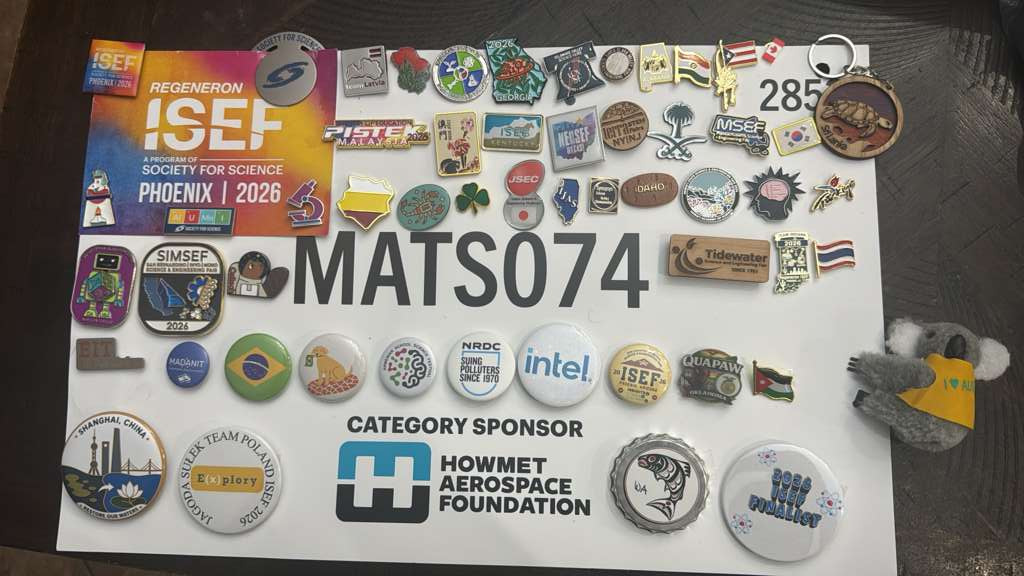
Rahul Madhu’s project board (MATS074) at ISEF 2026 in Phoenix, AZ, decorated with pins traded with student researchers from around the world. It is a beloved ISEF tradition that proves science knows no borders.
Student Successes: Aditi Srikanth
Representing the thriving Texas research landscape, Aditi Srikanth is a DRIPBL Year 2 student. She has built one of the most impressive multi-year research trajectories in the program. Beyond her scientific work, she also gives back to her community. She serves as President of WonderLab, a high school club she founded within CISD. The club brings fun, biology- and technology-focused STEM experiments to kids ages 8–12. As a result, Aditi is as committed to inspiring the next generation as she is to her own research.
Aditi has clearly mastered her state science fair prep. Microbiology, the study of tiny living things like bacteria, is her specialty. At the Fort Worth Regional Science and Engineering Fair (FWRSEF), she earned 1st Place in Microbiology in 2025. Then she repeated that win in 2026. Furthermore, the 2026 result earned her the Citadel Special Award.
Her success continued at the state level, too. She earned 1st Place in Microbiology at the Texas Science and Engineering Fair (TXSEF) in both years. In addition, she received Best of State Honorable Mentions and qualified for ISEF each time. Pictured below, she beams with well-earned pride while holding her awards.
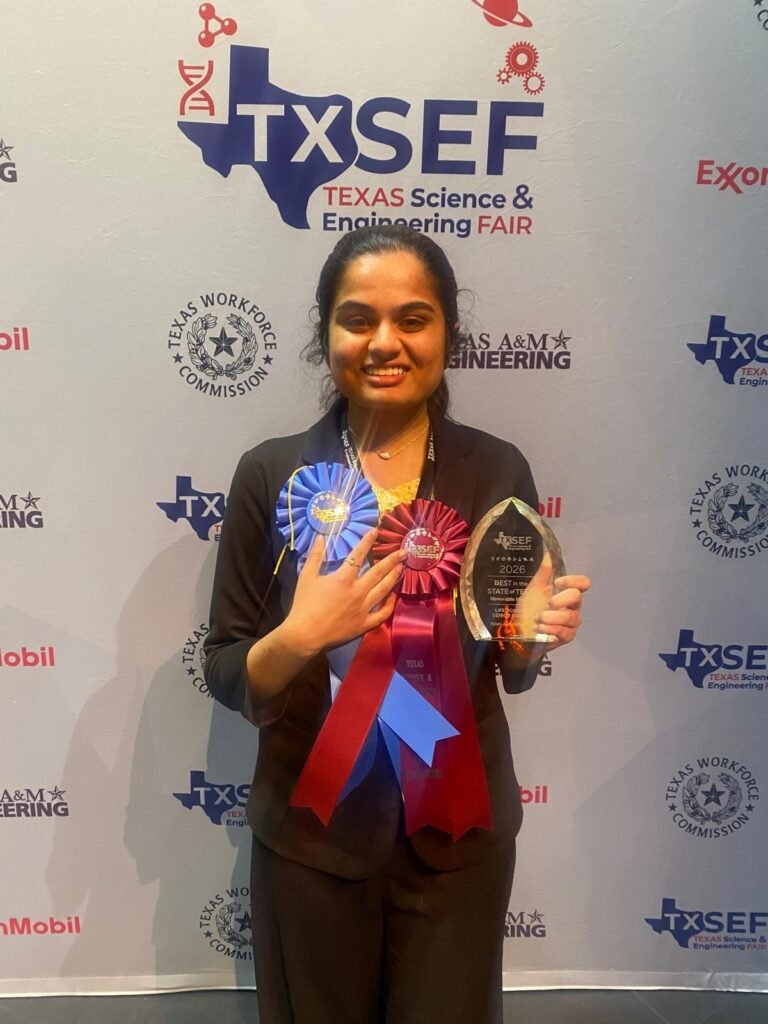
Aditi Srikanth beams with well-earned pride at TXSEF 2026, holding her crystal Best in State trophy alongside her 1st Place blue ribbon. This is only one of many honors that secured her return to ISEF as a two-time finalist.
Aditi’s talents also reach well beyond microbiology. She earned Finalist recognition in Business Professionals of America (2025) and HOSA (2026). Moreover, she placed 3rd at the Texas Junior Academy of Sciences (2025).
So how do you qualify for ISEF? For Aditi, the answer is elite, original research two years running. As a two-time ISEF Finalist, she first presented her 2025 project (MCRO020). Its full title is “Combating S. aureus Resistance: Inhibiting graRS with Hesperidin and Punicalagin and Development of Natural Treatment for S. aureus Infections.” S. aureus is a common bacterium behind many stubborn infections. Her project used the natural compounds Hesperidin and Punicalagin. Together, they fight antibiotic-resistant infections without traditional pharmaceuticals. In simple terms, these germs no longer respond to standard antibiotics.
Then she returned in 2026 with her expanded project (MCRO028). Its full title is “Targeting the GraRS Two-Component System in Staphylococcus epidermidis: Computational Identification and in vitro Validation of a Novel Adjunctive Cocktail Therapy for Antibiotic-Resistant Infections.” S. epidermidis is a related Staphphylococcus spp. bacterium. GraRS is a bacterial signaling system that helps germs survive. This study combined computational tools with lab validation. As a result, she developed a novel cocktail therapy, or a combination of treatments, for antibiotic-resistant infections. Therefore, her work earned international recognition for the second year running. Remarkably, it did so in one of the most competitive ISEF categories. In addition, a peer-reviewed journal recently published this work in Volume 3 of the Future Scholars Journal (page 32).
Aditi Srikanth presents her 2026 ISEF research which focused on Targeting the GraRS Two-Component System in Staphylococcus epidermidis — a computational and lab-validated approach to combating antibiotic-resistant infections that brought her international recognition for the second year running.
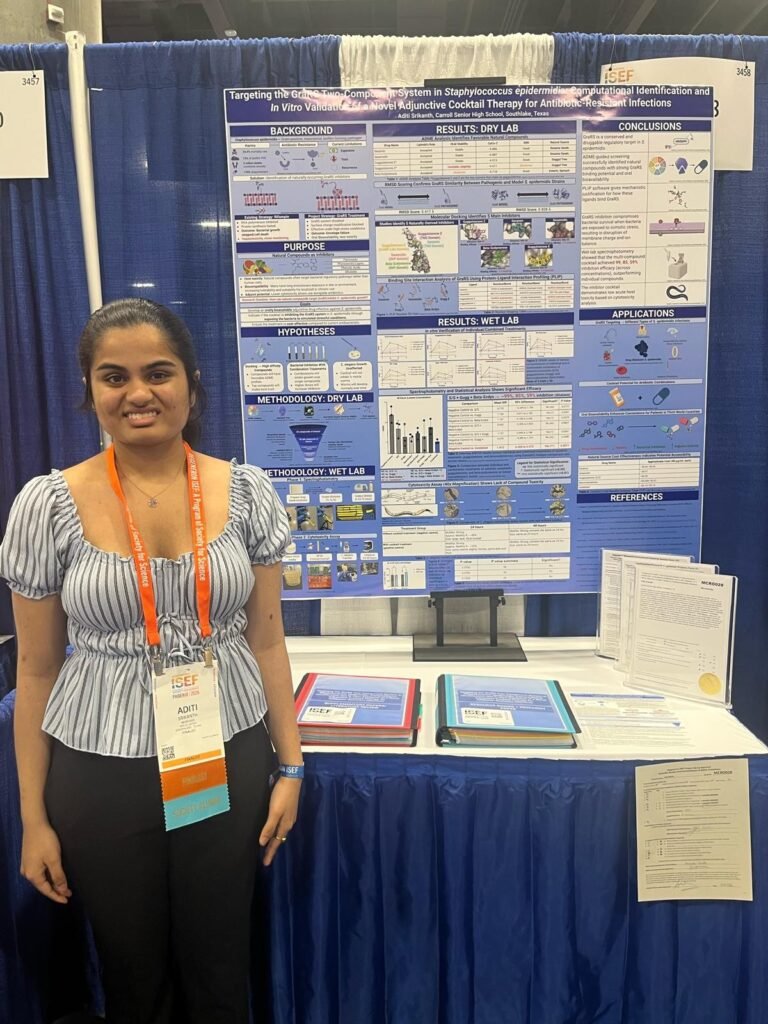
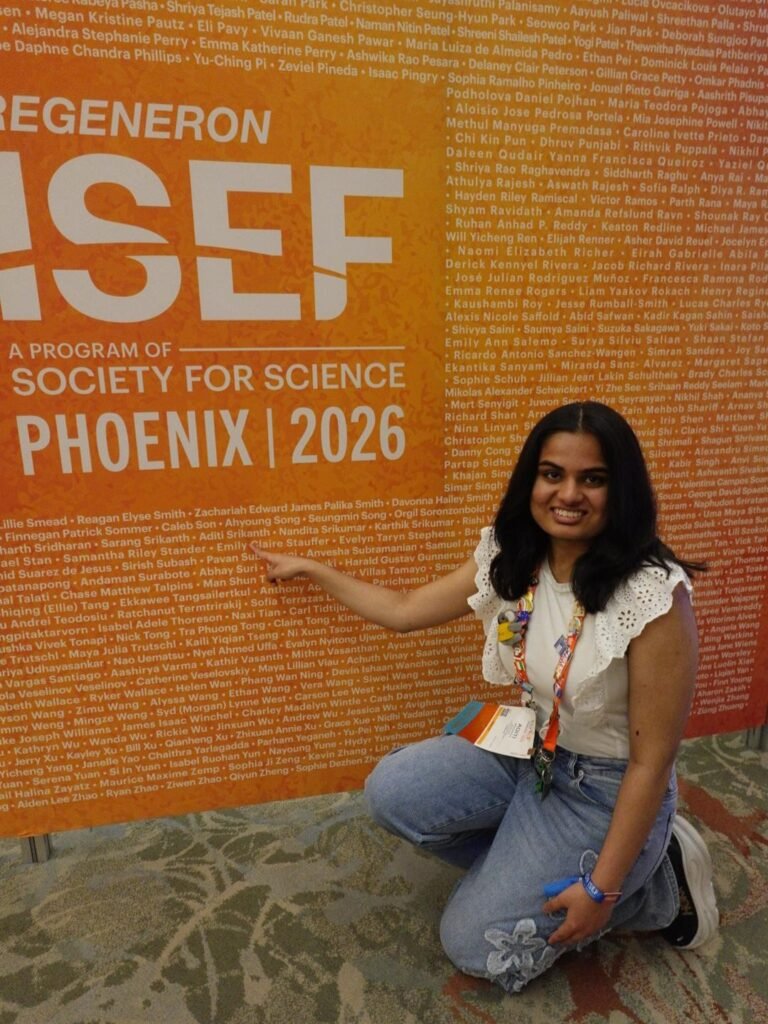
(Left) Aditi Srikanth at Regeneron ISEF 2026 in Phoenix, AZ pointing to their name mentioned on the list of contestants.
Student Successes: Diya Shah
Representing Arizona College Prep High School, Diya Shah is a DRIPBL Year 2 student. Her independent research sits at a fascinating intersection of mathematics and medicine. Furthermore, her work reflects advanced high school science mentorship in computational mathematics. That field uses math and computers to solve real problems.
At the state level (AzSEF 2026), she earned 1st Place in the Senior Division for Mathematics. In addition, she received the Society for Science / UofA / Avnet Special Award. This honor goes only to the state’s most creative innovators. Therefore, it serves as a powerful reminder of Diya’s greatness among Arizona’s top young scientists. Her work has also garnered significant national acclaim. That same year, she swept the National Innovator Challenge 2026. As a result, she took home both the Best Innovation Award and First Place. In addition, she earned recognition as a 2025 award recipient in the GGA Contests. The Genetics and Genomics Academy (GGA) at NC State University hosts these life-science competitions.
Showcasing the power of STEM coaching for high schoolers, Diya competed as an ISEF 2026 Finalist. Her project ran in the Translational Medical Sciences category (Booth ID TMED088). She brought her advanced dry-lab approach to the world stage. A dry-lab approach uses computers and data instead of physical experiments. Her full project title is: “NeuroTracer: Unraveling Prediagnostic Signals for Early Onset Parkinson’s Disease From Archimedean Spiral Drawings Using the 2D Wavelet Transform, Recurrence Quantification Analysis, and Convolutional Neural Networks.” In plain terms, it blends advanced math with artificial intelligence to read Archimedean spiral drawings. These are simple spiral shapes a patient draws by hand. Parkinson’s disease is a brain disorder that slowly affects movement. Impressively, Diya is also a patent-pending student. In other words, she has already filed to protect this original invention, which is rare in high school. In addition, a peer-reviewed journal recently published this work in Volume 3 of the Future Scholars Journal (page 19). Neurodegenerative diseases are conditions where brain cells slowly break down. Therefore, her research suggests that algorithms could transform how doctors catch these diseases early.
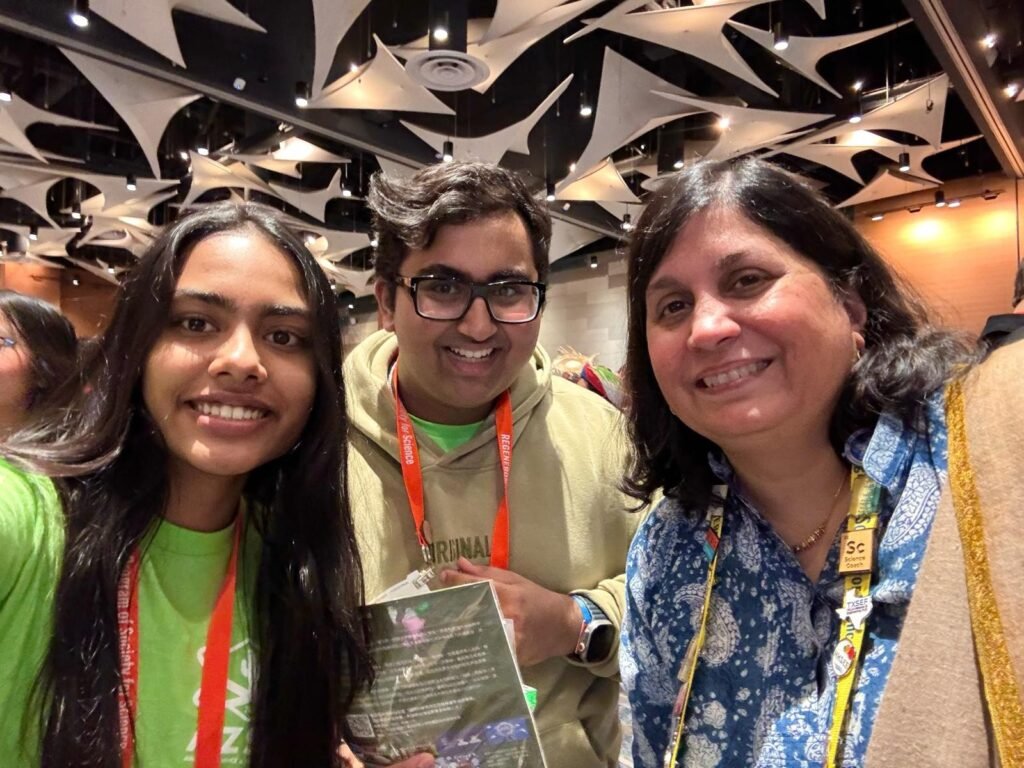
Diya also understands the value of connection. This shows the importance of networking within a high school science mentorship program. During the public day at ISEF, she made important professional contacts. For example, she networked directly with Maya Ajmera. Ajmera is the President and CEO of Society for Science and the Executive Publisher of Science News.
Photographed from left to right: Diya Shah, Rahul Madhu, and Maya Ajmera the President and CEO of Society for Science and the Executive Publisher of its award-winning magazine, Science News. These students are showing the importance of networking during the public day. They made some important connections!
Student Successes: Rathan Duggirala
DRIPBL connects driven students with expert mentors, wherever they live. As a result, Rathan built a world-class research record from Minnesota. Therefore, his story shows that distance is no obstacle to elite science.
Rathan’s work centers on material sciences, the study of what everyday materials are made of. He focuses on biologic paints, which use natural, bio-based ingredients instead of harsh chemicals. As a result, his research is both innovative and eco-friendly. Moreover, it tackles real problems in safety and sustainability.
His momentum first showed at MnMAS 2025. There, he earned a Gold Award at the Minnesota State Science and Engineering Fair. In addition, he won 2nd Place for the Medtronic Innovation Award, which included a $500 prize. Together, these honors powered his path to the international stage.
As a two-time ISEF Finalist, Rathan competed on the world stage in back-to-back years. He first qualified in 2025 with his project (MATS015). Its full title is “Optimizing Biologic Paint Drying Time With Cellulose Nanocrystals and Chitosan Additives.” In plain terms, he tested tiny natural fibers to help eco-friendly paint dry faster. Cellulose nanocrystals come from plants, while chitosan comes from natural sources like shellfish. Furthermore, he benchmarked these additives against commercial paints. This means he measured his formula against store-bought products.
Then Rathan returned to ISEF 2026 with an exciting new project (MATS023). Its full title is “Toward Safer Nail Cosmetics: A Randomized in vitro Performance Study of a Novel Natural Biologic Nail Paint.” In simple terms, he developed a safer, nature-based nail polish. An in vitro study means the testing happened in a controlled lab setting, not on people. As a result, his work points toward healthier beauty products made from natural ingredients. Therefore, Rathan proves that with the right mentorship, geography is no barrier to world-class science.
Conclusion: The Next Generation of Scientific Leaders
The collective impact of Rahul Madhu, Aditi Srikant, Diya Shah, and Rathan Duggirala serves as a powerful indicator of where STEM is headed. The honors they secured are not merely school-age accolades; they are the early markers of professional careers that will likely redefine medicine, behavior, and mathematics.
As the organizers of AzSEF 2026 rightly noted, the “creativity, innovation, and ingenuity” displayed by these students is truly inspiring. They have proven that they are no longer simply scientists of tomorrow, they are the innovators of today! As we celebrate their success, we must ask: How can we further dismantle the barriers to entry for these young minds, ensuring that their current ingenuity in high school student research translates into the life-saving breakthroughs of the next decade?
References
Arizona Science Center. (2026). AzSEF 2026 awards winners. https://www.azscience.org/visit/events/arizona-science-engineering-fair-azsef/awards/.
Chandler Unified School District. (2023, February 28). Chandler Unified School District weekly news update 2-28-2023. Smore. https://www.cusd80.com/chandlerschools.
National Center for Biotechnology Information. (n.d.). JNK in tumor microenvironment: Present findings and challenges in clinical translation. PubMed Central (PMC).
National Center for Biotechnology Information. (n.d.). JNK pathway inhibition enhances chemotherapeutic sensitivity to Adriamycin in nasopharyngeal carcinoma cells. PubMed Central (PMC).
National Center for Biotechnology Information. (n.d.). JNK1 inhibition attenuates hypoxia-induced autophagy and sensitizes to chemotherapy. PubMed.
National STEM Festival. (2025). 2026 National STEM champions – U.S. EXPLR PBC INC. https://www.nationalstemfestival.com/champions-us/2026-finalists
Sigma Xi, The Scientific Research Honor Society. (2023, November 15). Student researchers awarded, inducted at IFoRE.
https://www.sigmaxi.org/news/news-archive/2023/11/15/student-researchers-awarded-inducted-at-ifore