
Introduction: Connecting Data Science to Real-World Impact
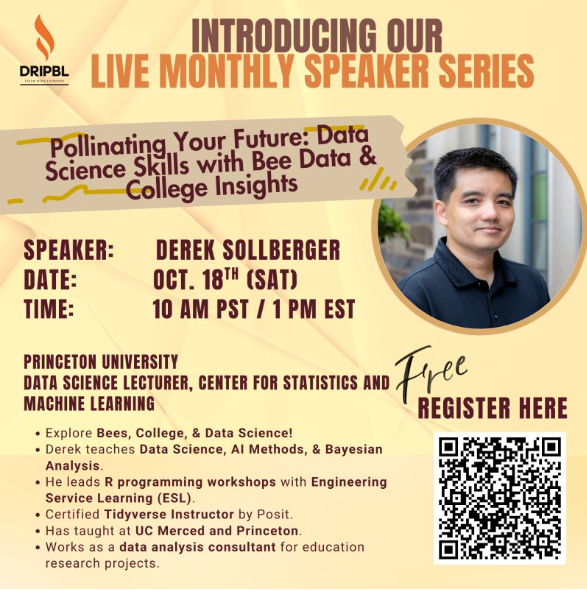
This article is a synopsis of the DRIPBL Live Monthly Speaker Series session titled “Pollinating Your Future: Data Science Skills with Bee Data and College Insights.” The event featured Derek Sollberger, a data science lecturer at Princeton University, who shared how dashboards can make data accessible, why programming skills matter, and how students can prepare for college and careers in data science.
The workshop brought together high school students, parents, and educators to explore how data science connects to environmental issues and educational opportunities.
You can watch Derek Sollberger’s talk here:
From Bee Data to Dashboards
Derek began with a question: What does data science have to do with bees? Using USDA bee colony data, he demonstrated how thousands of rows of numbers can be transformed into interactive dashboards that tell a story.
A data science dashboard is an interactive tool that turns raw data into charts, maps, and filters that anyone can explore. Derek used Quarto, a free framework that works with R and Python, to show how dashboards can:
- Combine text, code, and visuals in one document
- Include interactive features like sliders and dropdown menus
- Publish as web pages for easy sharing
Through the dashboard, participants could filter by state and year, compare colony losses and gains, and spot seasonal trends. Suddenly, data was not just numbers—it was a story about agriculture and climate change.
R or Python: Which Should You Learn First?
Students often ask which programming language to start with. Derek explained:
- R is excellent for statistics and visualization, making it ideal for research projects.
- Python is widely used for machine learning and artificial intelligence in industry.
Both are free and supported by large communities. Derek’s advice: choose the one that matches your interests. If you enjoy charts and research, start with R. If you want to explore AI, go with Python.
College Preparation Tips for Future Data Scientists
Derek emphasized that data science is about curiosity and problem-solving, not just coding. His advice for students:
- Learn a programming language before college. Even basic skills will help you stand out.
- Use free tools. Platforms like RStudio Cloud and Google Colab let you practice without expensive software.
- Explore programs like QuestBridge. They help high-achieving students from low-income families access top schools like Princeton.
- Build a portfolio. Share small projects on GitHub to showcase your skills.
College Prep Roadmap for Aspiring Data Scientists
Derek shared practical advice for students who want to study data science in college:
Freshman and Sophomore Years
- Focus on math and science courses.
- Start exploring coding through free platforms like Codecademy or DataCamp.
- Join STEM clubs or competitions.
Junior Year
- Learn a programming language (R or Python).
- Begin building small projects and share them on GitHub.
- Research programs like QuestBridge for college opportunities.
Senior Year
- Finalize your portfolio with dashboards or data analyses.
- Apply to colleges and scholarships early.
- Consider writing about your data projects in your application essays.
Extra Tip: If your school does not offer advanced STEM classes, use free resources online. Many top universities value initiative and self-learning.
Will AI Replace Data Scientists?
The short answer is no. AI can automate some tasks, but humans are still needed to ask the right questions, interpret results, and communicate insights. Derek encouraged students to learn how AI works because it will make them more competitive. Tools like scikit-learn for Python or caret for R are good starting points.
Key Takeaways
- Dashboards make data interactive and easy to explore
- R and Python are both useful; choose based on your goals
- College prep includes building skills and a portfolio
- AI is a tool, not a threat; learn how to use it
- Free resources can help you start today
- Coding tutorials: Codecademy, DataCamp
- Open datasets: USDA Bee Colony Data, Kaggle
- Community support: Stack Overflow, Reddit’s r/datascience
Closing Thoughts
Data science is more than numbers. It helps us understand the world. Whether you are studying bees or predicting trends, turning data into insight is a powerful skill.
Start small. Pick a dataset that interests you. Make a simple chart. Share your work. Each step brings you closer to a future where you do not just read information. You create it.
Written using aid from Copilot